
Let's Bring Back Shame
It has its uses.

Social life is a game—always has been, always will be—meaning that as long as there are humans, there will be winners and losers.
Humans are surprisingly okay with the existence of winners and losers. An alien anthropologist might even claim that we crave the distinction. But we are also strict about the process: it must be fair. Only when the game is fair do people feel comfortable honoring the outcomes.
American society is withering on the vine, I think, largely because its social game is unfair. The rules are not clear, consistent, or equally-applied. This leaves us confused—and often angry—about having clear winners and losers nevertheless. How are these winners and losers being determined?
Many societies throughout history had bigger gaps between winners and losers. (And some presently. In the Indian caste system, for exampe, the lower caste isn’t considered the same degree of human.) These societies, though, typically had stronger explanations for why some people were winners and others losers. These explanations—or rules of the game—weren’t necessarily fair in and of themselves. But at least everyone was on the same page.
What about in America? Seriously, how does a person get to be a winner in our society? Hard work? Luck? Privilege? Talent?
More to the point, what is a good person in our society? Someone who gives back, or grows their wealth? Someone who is humble or brash? Someone who cooperates or renegades? Someone who follows the rules, seeks to change them, or manipulates them to their advantage? I genuinely don’t know, and I suspect that most Americans don’t, either.
Perhaps even more to point—and here we approach my real gripe with American society—what is a bad person? Is it someone who opens their door at a stop light and throws a bag of trash on the ground? If so, then how come that person isn’t punished? Is it someone who tails the person in front of them at a four-way stop so they don’t have to wait their turn? Is it someone who brings a boom box into the subway, rides a bicycle on the sidewalk, double-parks wherever they want, or steals from Target?1
If these are bad things, then how come nothing bad attends them? In fact, these acts are rewarded. After all, a dollar stolen is a dollar earned.
A few years ago, fed up with the hypocrisy of our American game—in which, by the way, I am a clear winner—I began stealing from my grocery store. Each visit, I neglected to scan about 10% of my items in the self-checkout lane. I was tired of watching other people get away with stuff; I wanted to get away with something, too.
And you know what? I loved it. But I can say with a straight face that I don’t enjoy the act of stealing. It doesn’t give me a rush or anything. Nor does it rankle me to pay what I owe—I’m no tightwad. What I mind is the unfairness, the discrepancy, the implication that there are incentives for good behavior when, clearly, there are not. When I walked out of the store, it was a sense of justice that made me smile.
Rendering Justice
My guess is that the average American citizen—about whom, to be fair, I know next to nothing—is confused and angry about the rules of the American game.2 So many Americans want to understand the rationale behind the societal outcomes they observe. Many await, with less patience every day, a model of good behavior, an incentive structure worth participating in. People are asking to be directed, to be shown the way, to understand what it takes to be virtuous. In the absence of this, we are increasingly like children with permissive parents—spoiled and headed for trouble.
Someone who understands the rules of the game has an avenue for being a winner, contributor, or valued community member. But a clear set of rules also gives people something far more powerful: the ability to punish those who are violating them.
Now, in a modern society, there are really only two ways to correct behavior. The first is the law; the second is social norms.3
Believe it or not, America has a fairly functional legal system. Sure, it’s a bit absurd that the average citizen knows a small fraction of the laws. It’s even more absurd that nobody knows how many laws exist. It’s also kind of a head-scratcher that those who interpret and enforce the least impactful aspects of the law fare much better financially than those who interpret and enforce the most impactful aspects. A corporate lawyer can provide for their family much easier than a police officer or public defendant.
But at least we have laws and apply them roughly equally. Widespread corruption, or absence of law enforcement altogether, is the reality in many places of the world both today and in the past. Not so here. My main gripe with America’s “behavioral correction strategy,” then, is mostly at the social or cultural level.
Laws exist—and are generally enforced—for the most severe transgressions upon society. The injury that is befalling our country is not generally of this kind.4 Instead, our country is dying by a thousand cuts, is bleeding as a result of minor to moderate transgressions that fall below the threshold of law enforcement and squarely into the domain of what used to be called “decency.” We seem to have lost sight of the fact that just because something’s legal, doesn’t mean it’s right.
For example, I heard a story the other day about a nineteen-year-old who has been bullying his mother around for years. The mother is at her wits’ end trying to help him, and recently has begun fearing for herself as he continues to escalate the conflict. In the past, if this kid wasn’t already mortified by the thought of doing this to his mother, there would have been a line of people willing to slap some sense into him. Instead, the mother is getting the run-around from police officers and mental health professionals. Somewhat unfortunately, her son hasn’t done anything illegal.
Or how about this one: I was speaking to a newly-minted grandmother the other day about the joys of her new role in life when all of a sudden her face grew dark. She began telling me about the other grandmother, who wouldn’t lift a finger or spend a penny for her grandchild. Again, there is absolutely nothing illegal here, but is this the society we want to live in? Where there is no recourse to remediation, nothing upon which we could appeal to this other grandmother to—care?
Similarly, what can we do about:
people who routinely show up late or cancel last minute (especially to dates)?
students who sit on their phones in class?
telemarketers?
drivers who pass in the exit lane?
litterers or spitters?
airline passengers who board before their zone?5
Most of the work in our society has to be done at a cultural level because even the actions above that are illegal are rarely punished. If only there were a mechanism to enforce the kind of behavior that benefits everyone and not just one person! Oh wait, there is. It’s called shame.
The Shame Game
In America, we’ve become about as allergic to shame as we have to gluten. It is one of the worst emotions a person can feel or make another person feel. (Ironically, it’s okay to shame someone for shaming someone.) Are we surprised by the result? Shame and guilt are nothing other than innate deterrents and punishments for violating group norms. When we take away their power, the social fabric disintegrates. The social fabric is indeed held together by these emotions.
I mean, what besides shame could prevent me from shouting into my cell phone on the train home? Instead, armed with the modern discourse of finding and brandishing my full and unvarnished self, I bellow like Stanley Kowalski about my fantasy team for all and sundry to hear.
Are we seriously blind to the costs of removing social laws and social law enforcement? I guess it shouldn’t be that surprising given that some are blind to the costs of removing regular laws and law enforcement. (Yes, this is a dig at Defund the Police.)
As shame and guilt have gone the way of the Dodo, so many things that simply “weren’t done”—to borrow a phrase from Rob’s article on a similar topic—are now done. Cancelling a date last minute used to be considered…not even immoral or unethical, but just a shitty thing to do.
Is anything shitty anymore? Should I be concerned about violating any norms? Nah, you do you.
Yet imagine, just for a moment, a world in which:
If someone is hooked on drugs and stealing from stores, bankrupting their parents, and neglecting their children, we send them to an American gulag. (This would solve our infrastructure problem, teach people valuable skills, and clean them up in one fell swoop!)
If someone tails the car in front of them, or leaves their high-beams on in traffic, we put them in the stockades. (We ask them to clean up the produce after the event, too.)
If someone brings a boom box on the subway, we give them a dunce cap. (Made of sustainable materials, of course.)
As it turns out, there is such a world. It’s called Japan.
The Antidote to Douchebaggery
Just like the human skin, society has many layers of protection. The outer layer, the epidermis, equates to basic decency or common courtesy. For example: show up on time, hold the door for someone, carry an old lady’s groceries. Such niceties make society a, well, nice place to live. The second layer, the dermis, equates to moral rules. For example: stick to your word, respect the dead. Moral rules protect personal dignity and promote mutual respect. The final layer, the hypodermis, equates to laws. (I sincerely hope that you don’t need me to provide examples.) Among other things, laws protect us from material—including mortal—injury.
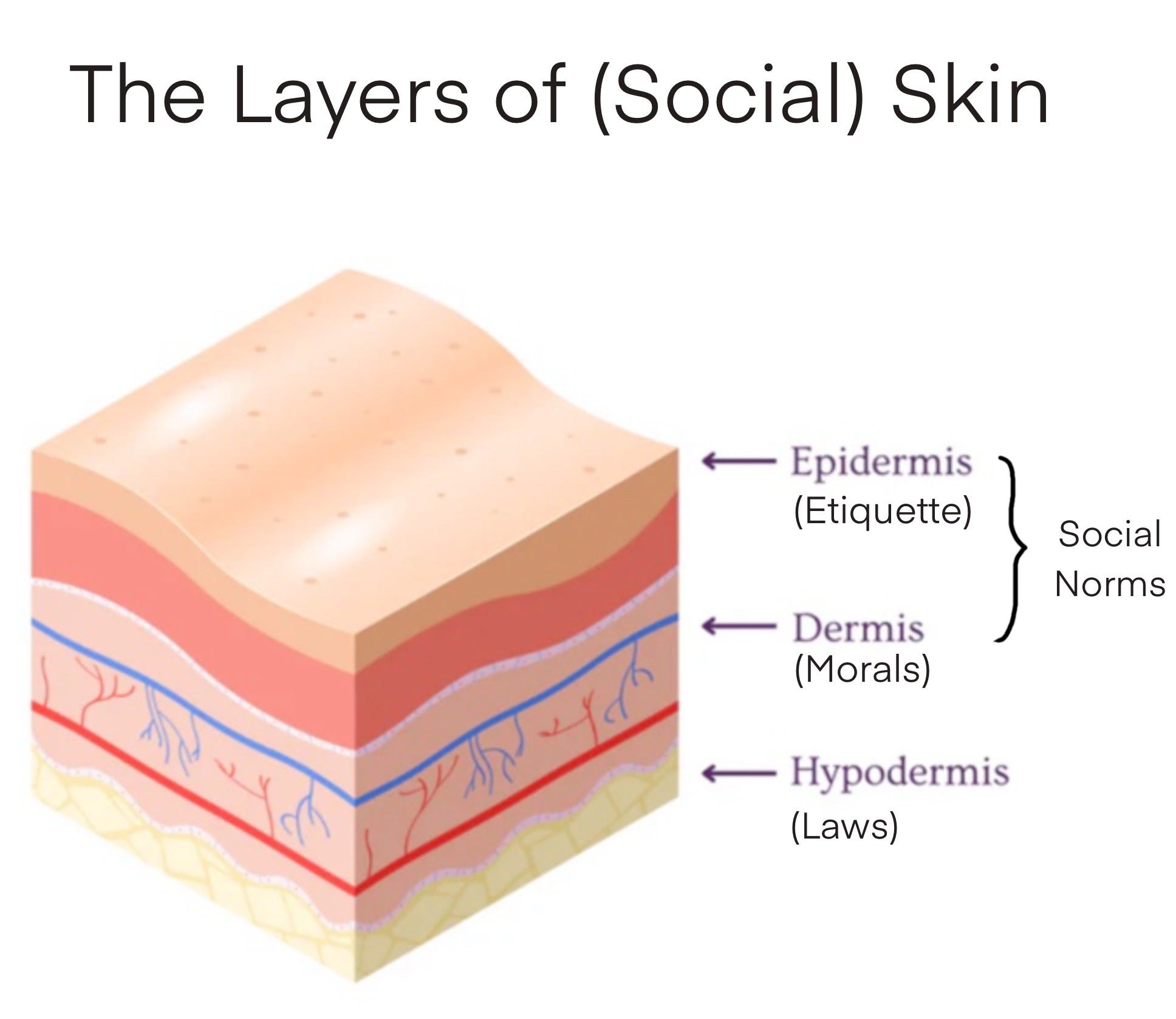
At the present moment in American society, people can get away with being a dick because there is a wide and widening gap between social enforcement and law enforcement. The first two layers of skin have been overly thinned, and the protection of our society is relying too much upon that final layer. Douchebaggery is rampant as a result.
Imagine once again—except more seriously this time—what it’d be like to live in a society where:
People cared about their community—and so would never insult it
A good person was communally defined—and not individually concocted
Bad acts were punished far more often than ignored
People asked what they could do for the commonwealth—and not what the commonwealth could do for them
Mutual respect was the sine qua non of most interactions
Japan isn’t the only country capable of this. I daresay older Americans can imagine—by which I mean, remember—this kind of society well, which must make our current reality all the more disappointing.
In the end, a strong moral code pervades the cracks where law enforcement cannot reach. It touches upon the unremarkable moments of a person’s day, which nevertheless comprise the bulk of their existence. Often, these “pennies in a jar” moments do not even register to consciousness or encode in memory, but make no mistake that our impression of the world around us, which informs the person we strive to be, is made of these minor scenes.6
Does someone acknowledge us on the street? Do we see someone throw—or pick up—trash on the sidewalk? Do we observe people cleaning up after their pets? Do drivers use their horn judiciously? Do shoppers hold the door for those behind them? Do we see moderate transgressions being punished, either by the law, disgust, or an appeal to morality? Is there a sense of common good, or shared purpose?
In short, do we show respect to each other and our community? Are we on the same page when it comes to what a good person looks like in our society?
If we do, and if we are, someone please show me.
CODA: How do we turn this around?
Some reviewers asked me to think of solutions, while others provided their own. I was in too much of a defeated mood to do that, but I’d genuinely love to hear from readers who have any ideas. How do we turn this around? What can the average person do to contribute to a common decency? Share your thoughts below.
The subreddit “Am I the asshole?” might be a perfect example of this. We’re so confused about what constitutes good and bad behavior that we have to turn to an internet forum to find out. God help us!
I am sympathetic to the argument made by Gary Gerstle that “a new political order” followed the 2007-2009 financial crisis, one based on the perceived unfairness of bailouts.
In this context, norms are synonymous with morals, conventions, customs, and so on. Really, whatever term you want to use to describe the socially- or culturally-held beliefs about good and bad behavior that are not proscribed by the law.
Although it might be soon, lol.
Somewhat hilariously, American Airlines recently developed a technology to punish those who try to board before their zone. This is a great example of technology priming those ancient emotions of shame, guilt, and embarrassment to address a sublegal transgression. I’m all for it, but it’s also sad that we need it.
As I am sure you can tell, for me it is much more conscious. I see someone spit on the sidewalk and decide to steal a muffin.
At home, I often tell my husband that “shame gets a bad wrap.” Sometimes I say this to reassure myself that one of our children’s crestfallen expressions after having transgressed and been reprimanded for it is no mortal sin on our part.
As a parent, I feel shamed for thinking that guilt and shame are healthy, vital emotions kids need to feel to grow up into decent people. The idea that shame is so much worse than guilt — and is somehow to be avoided at all costs (due to its erosiveness on all-important self-esteem) — seems so misguided.
The key is appropriateness. The punishment (including the emotional one) should match the crime. If a child is beating themselves up more than is called for, we instantly go into comfort and soothe mode; it’s not for us to make them feel worse. But sometimes they need to be made aware that shitty behavior is shitty, and that’s something they need to feel and learn to deal with.